
Executive Summary
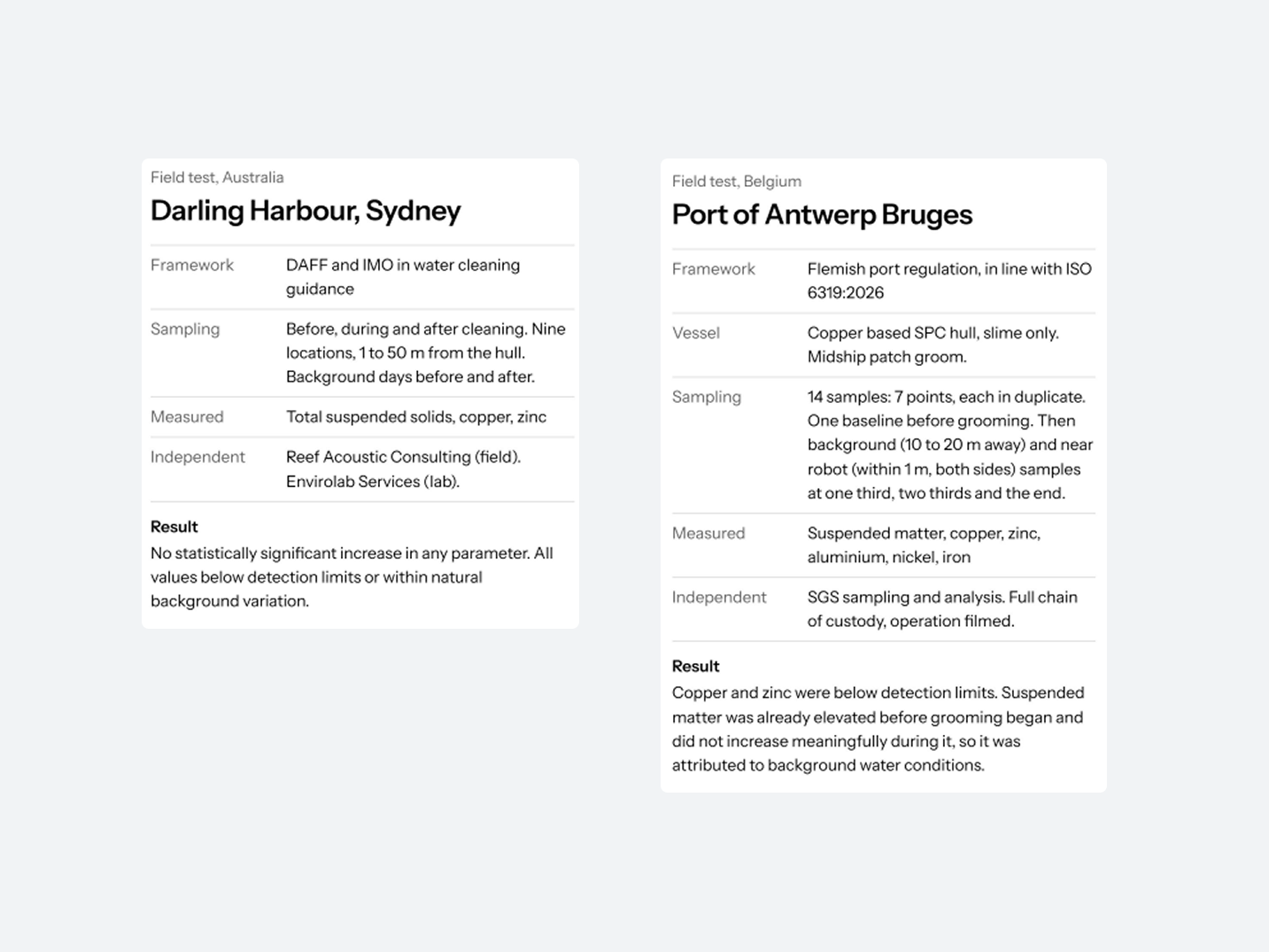
In-water cleaning has long raised concerns about what enters the surrounding water, particularly biocides from antifouling coatings and suspended solids dislodged from the hull. Hullbot commissioned two independent field tests, in Sydney, Australia and the Port of Antwerp-Bruges, Belgium, to measure water quality during robotic hull grooming. Sampling and laboratory analysis were carried out by accredited third parties (Envirolab Services and SGS).
Neither site showed a measurable increase in copper or zinc, including during grooming of a copper-based self-polishing coating (SPC). The findings support the case that frequent, gentle grooming of early-stage fouling can be carried out without measurable water quality impact.
Background
Regulators and port authorities increasingly ask a simple question of in-water cleaning: what does it release? Conventional cleaning of heavily fouled hulls can disturb coatings and mobilise both biological material and metal-based biocides. Hullbot's approach differs in principle. By grooming hulls early and often, the robot removes slime and light fouling before it establishes, which reduces the mechanical intensity needed and, in turn, the potential for coating disturbance.
Water quality testing provides the evidence for this. Samples are taken close to the robot and at a distance, before, during and after grooming, and an accredited laboratory analyses them for biocides, metals and suspended solids.
Methodology
Two separate independent water quality testing, using two different accredited laboratories are used to provide strong validation on the impact of Hullbot grooming practice.
Sampling layout. Schematic, not to scale.
Conclusion
Two independent field tests across two jurisdictions and regulatory frameworks found no measurable increase in copper or zinc during Hullbot grooming. These results support a proactive grooming model, keeping hulls clean before fouling establishes, as a way to deliver hull performance and fuel efficiency benefits without measurable water quality impact.
Full data is available on request.